
AvoMate
AI-powered ingredient tracking that helps households reduce food waste.
Role
Project lead · Research Lead · UX Design · Prototyping
Overview
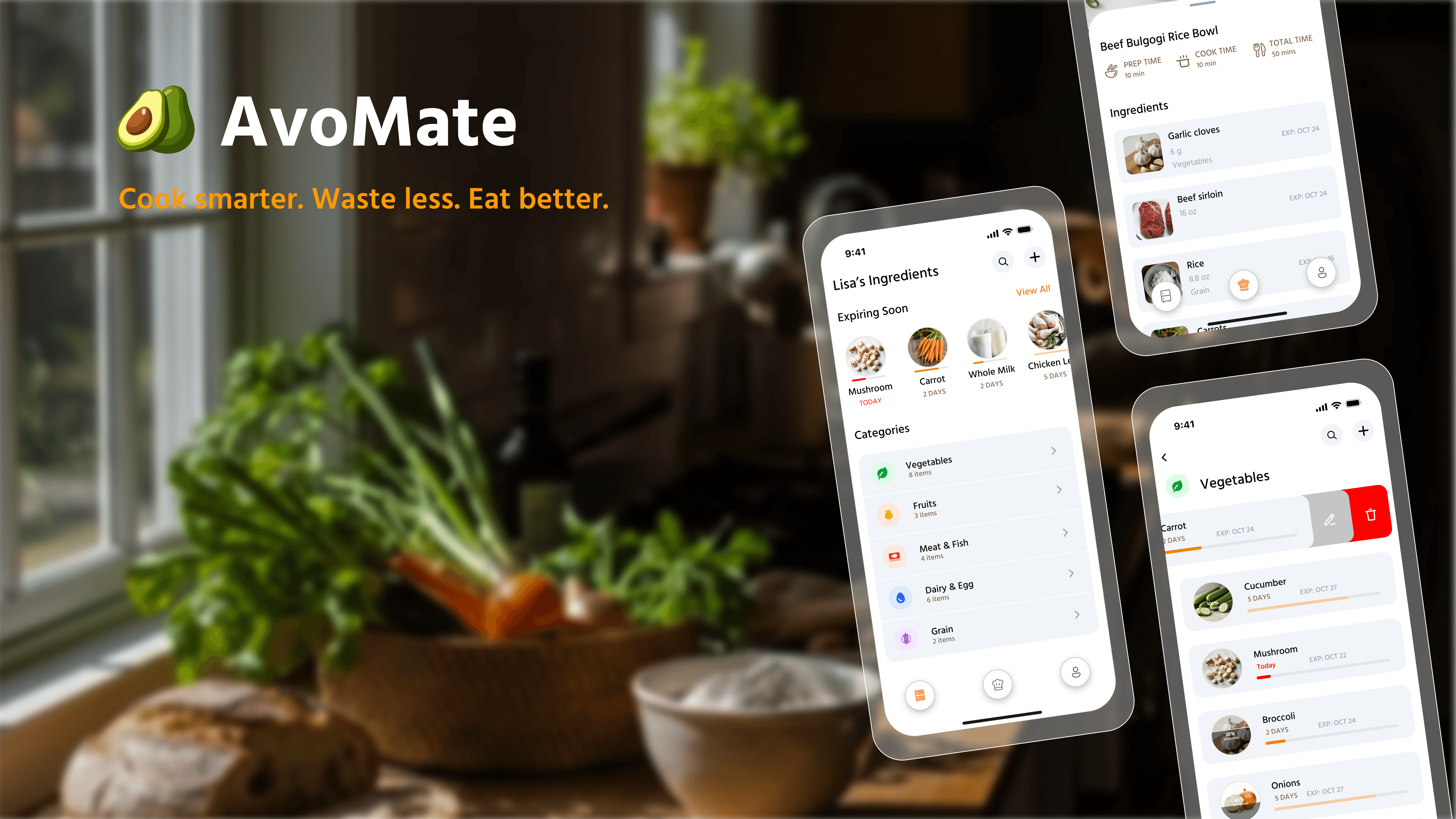
AvoMate is an AI-powered food assistant that autonomously tracks ingredient freshness, delivers timely reminders, and suggests meals based on current ingredients, helping households reduce food waste through intelligent, real-time support.
As the Project Lead, I drove the end-to-end experience design, exploring how AI could enable lightweight, everyday decision-making in the kitchen. This project strengthened my ability to design user-centered experiences, evaluate technical trade-offs, and translate complex systems into intuitive everyday interactions.
Timeline
Jan - Mar 2025
Team
Shan Huang
Yuqi Cao
Tools
Figma, Miro, Photoshop, After Effects
The challenge
Households told us, “I don’t remember what’s in my fridge until it’s already bad.” While many participants expressed concern about food waste, they still relied on memory to manage ingredients, and existing tools assumed advance meal planning, adding friction to busy routines. Driving technical innovation to build lightweight, AI-powered systems with real-time freshness awareness became the core challenge.

Goal Statement
To design and validate a mobile application within 70 days that helps households earning less than $50,000 to 100,000 annually reduce food waste, with the potential to save approximately $728 per person per year.
Impact / Outcome
Improved ingredient visibility and reuse behaviors
Food waste
Potential savings of $728 per person per year
Cost awareness
Validated low-effort workflows for busy households
Everyday usability
Pain Points
These everyday moments of uncertainty accumulate over time, turning good intentions into unnecessary food waste.

01 Ingredients spoil quietly
Poor storage and long keeping cause food to expire without clear signals. Many users don’t realize ingredients have gone bad until they already need to be thrown away.

03 Plans change
Busy schedules and last-minute decisions interrupt cooking plans, leaving previously purchased ingredients unused.

02 Out of sight, out of mind
Ingredients often get pushed to the back of the fridge and hidden behind newer items. Once out of view, they’re easily forgotten.

04 Freshness is hard to judge
Without reliable cues, users rely on guesswork to assess freshness, smelling, touching, or throwing food away just to stay safe.

The solution
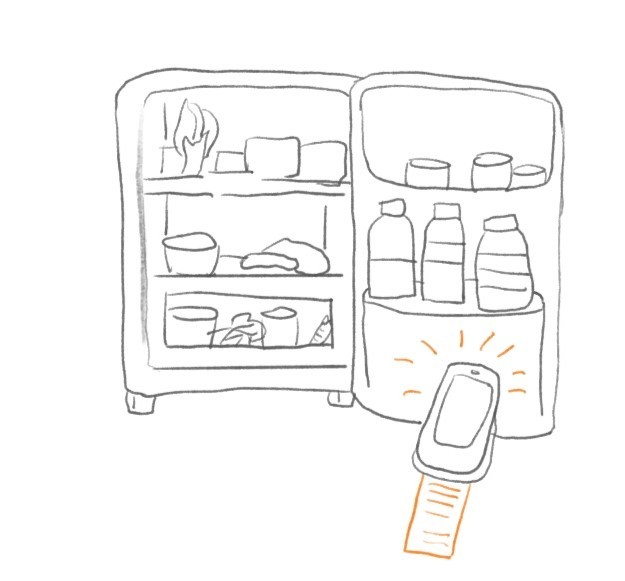
When you forget what’s still fresh, AvoMate tracks ingredients freshness automatically. Before items expire, it sends timely reminders and recipe suggestions to help you use them.

“Your carrots expire in 2 days. Want recipe ideas?”
“I don’t remember what ingredients are still fresh…”
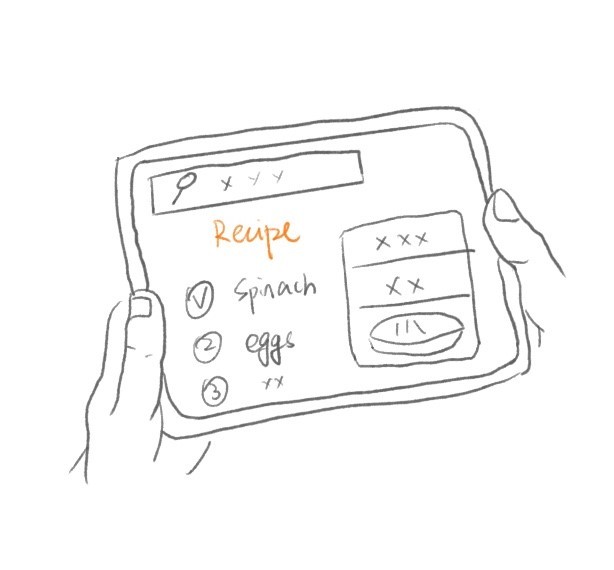
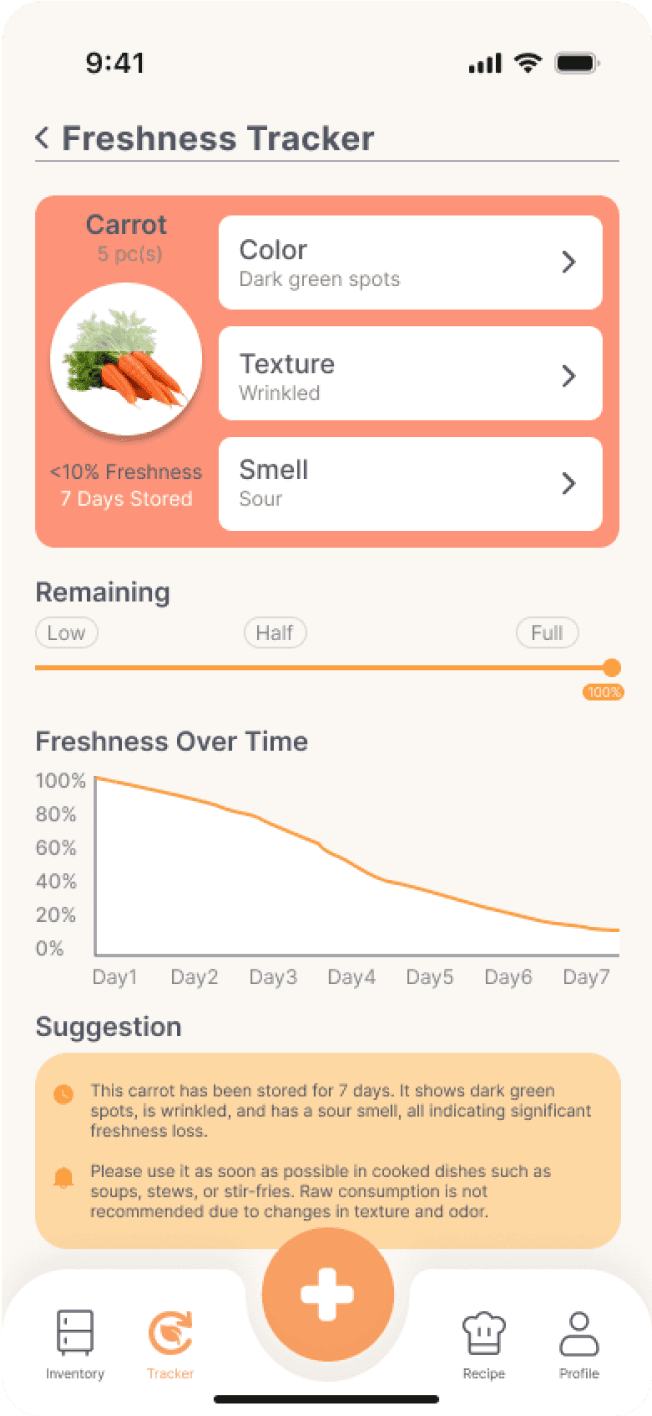
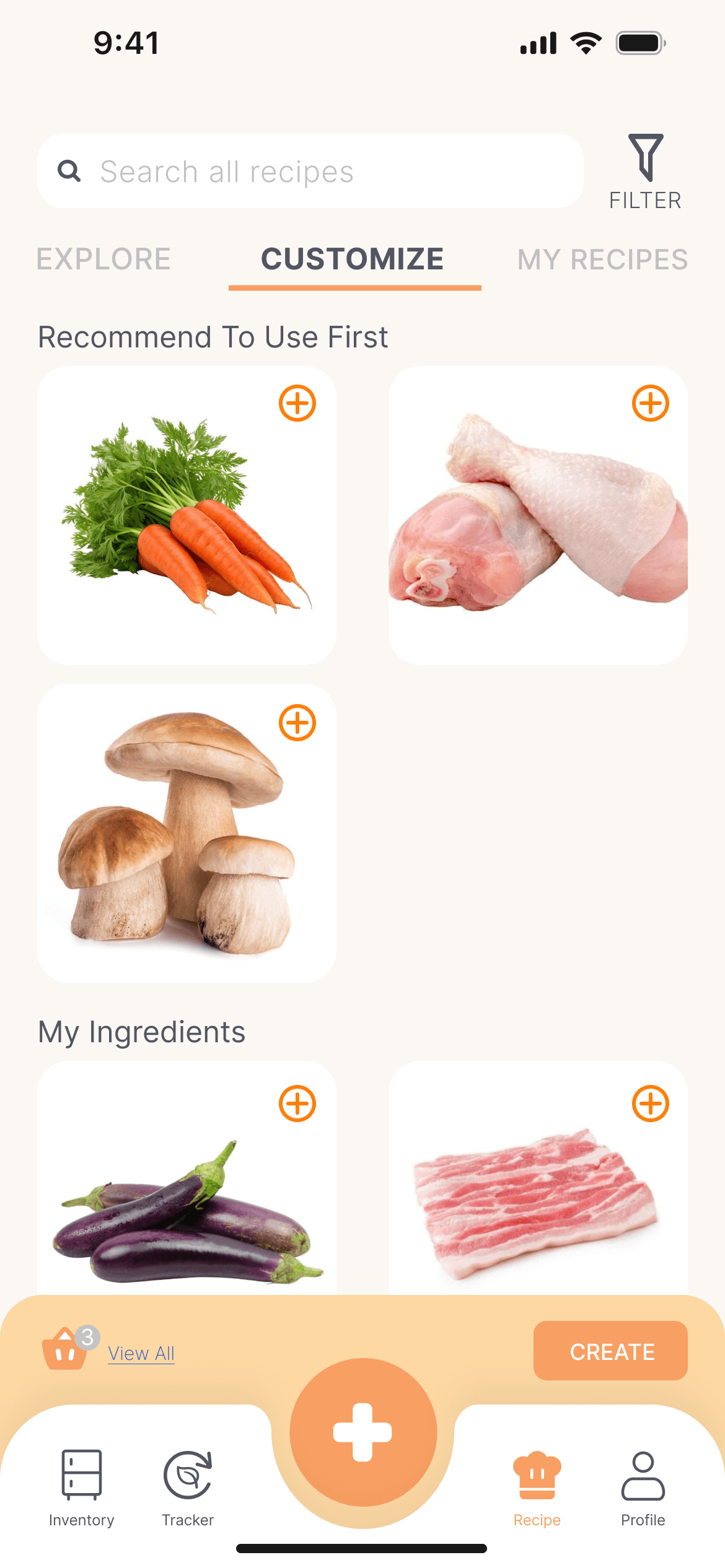
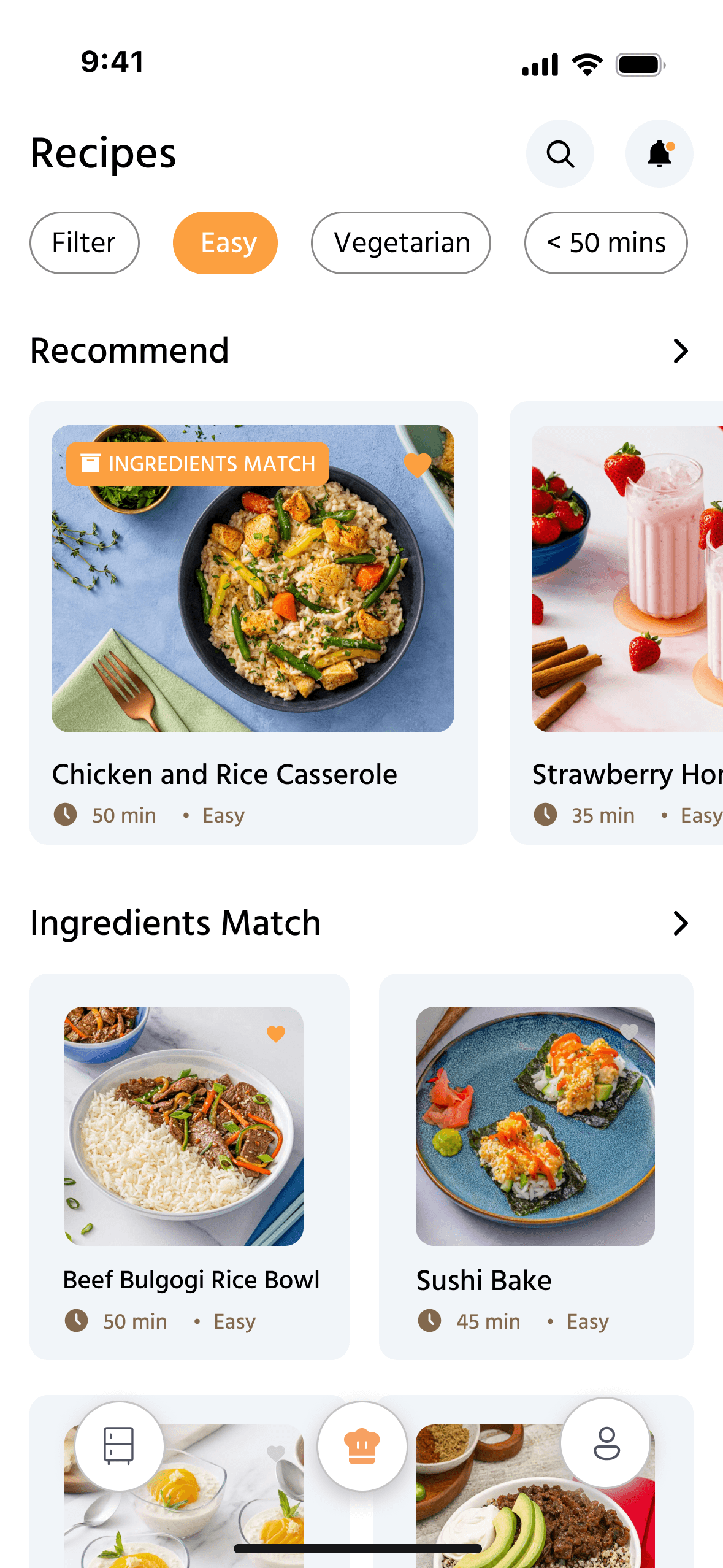
Users can quickly review ingredients freshness and see what should be used first. When an item is close to expiring, AvoMate highlights it with urgency cues and recommended actions. From there, users can view recipes based on available ingredients.

“Let me check what ingredients I have and what I should use first.”
Multiple entry methods, including manual input, camera scanning, and receipt recognition, enable fast ingredients capture from details, photos, or receipts, lowering setup friction and making inventory building effortless.
After cooking, users can edit the remaining amount of each ingredient or quickly delete items from inventory, ensuring freshness status stays up to date.
AvoMate visualizes the real-world impact of everyday ingredient decisions. Users can track waste reduction, money saved, and meals created from existing food, turning mindful cooking into measurable change.

That was easier than I expected! Such a delicious dinner!
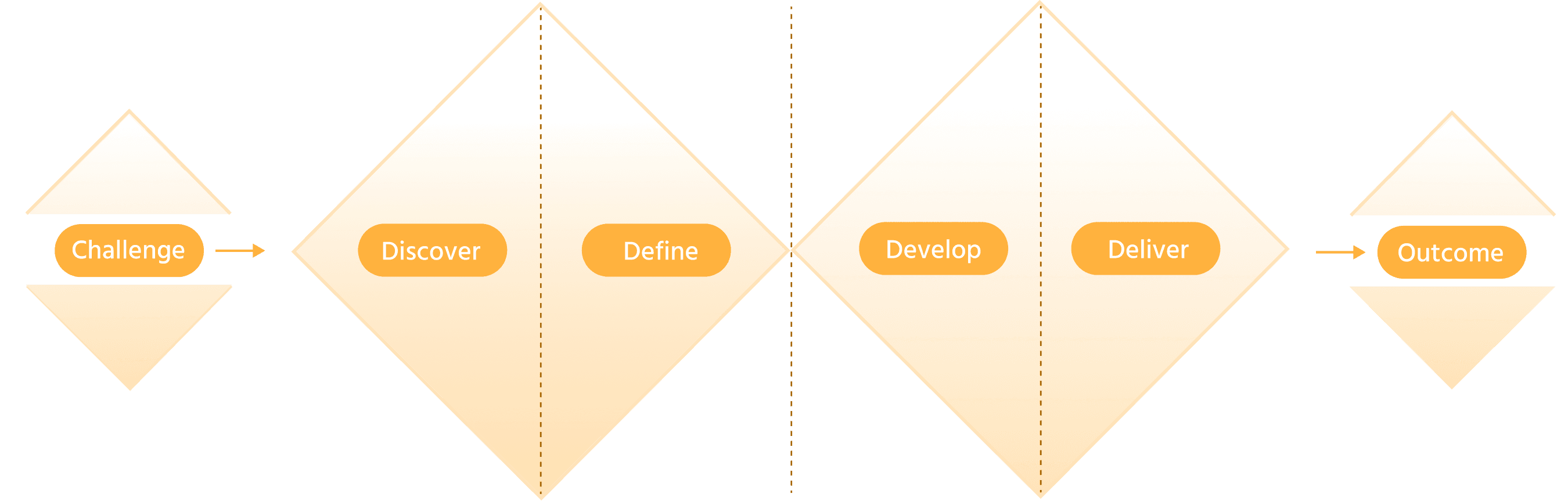
Design process
Affinity diagram
Competitive analysis
Discover
Define
Desk research
Problem statement
Model experience wheel
In-depths interview
Ecosystem map
User journey map
Persona
Develop
Deliver
UI design
Interaction design
Prototype
User testing
Feedback
Wireframe
Challenge
Outcome
Product journey map

Deck research
Why should we care about food household waste?
70.7 M tons
23.5 M tons
3.5 lbs
per person each week
68%
still edible
Very important
Less than $50,000
0%
10%
20%
30%
40%
50%
60%
59%
55%
52%
26%
30%
31%
7%
8%
9%
2%
2%
6%
6%
5%
1%
70%
Somewhat important
Not very important
Not at all important
Not sure
Share of respondents
$50,000 to 100,000
$100,000 and more
Less than $50,000
59%
55%
$50,000 to 100,000
35%
$100,000 and more
Very important
In 2024, 70.7 million tons of surplus food were generated across the U.S. food system, with households contributing 23.5 million tons, 33.2% of the total. On average, people discard about 3.5 pounds of food per person each week, and 68% of it is still edible. 52–59% of households earning less than $50,000 to 100,000 annually say reducing food waste is “very important”, revealing a critical gap between Awareness and behavior.
Environmental Impact

Household surplus food generates about 100 million metric tons of CO₂ annually

Water used to grow uneaten household food totaled 4.54 trillion gallons

Residential food waste also produces 1.13 million metric tons of methane
$ 728/yrs
Each consumer wastes money on food waste.
In the U.S.
$2,913/yrs
Average loss per household of four
In the U.S.
$56/wk
Weekly household food waste cost
In the U.S.
Source: U.S. EPA — Estimating the Cost of Food Waste to American Consumers
Economic Impact
In-depths interview
End-customer: households earning less than $50,000 to 100,000 annually who struggle with food waste
Interview goal
01 Identify common challenges users face in managing ingredients and reducing food waste at home
02 Understand users' habits, misconceptions, and concerns related to ingredients waste and tracking
03 Explore users’ emotion and attitudes towards reusing leftovers and ingredients appearance

12
Interviewees
344
Data points
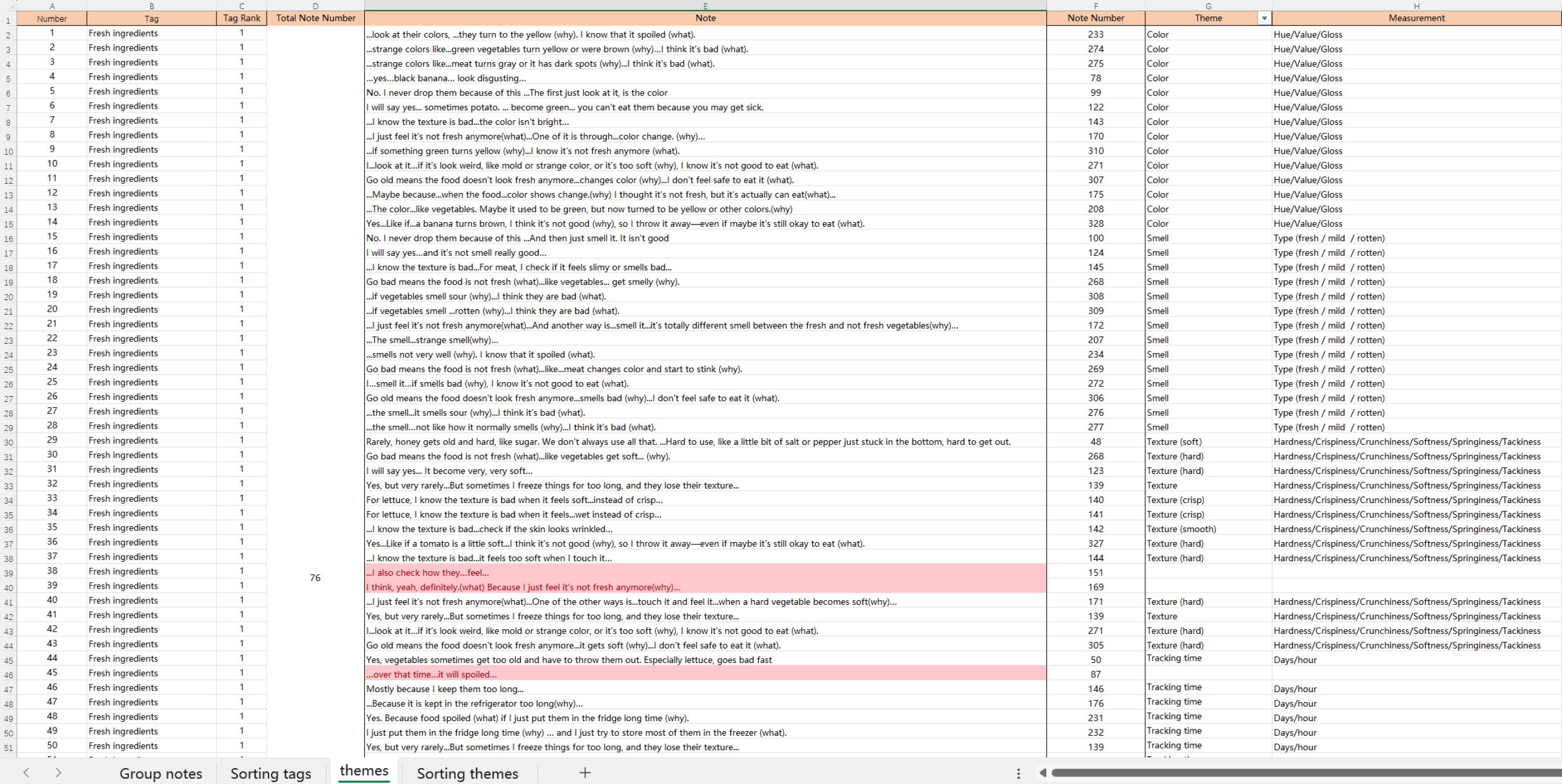
It became clear that food waste isn’t simply caused by carelessness, but by everyday cognitive overload. Although most participants genuinely wanted to reduce waste, they struggled to follow through. They often forgot what was in their fridge, rely on subjective freshness cues, and fail to act in time. These small breakdowns led to frequent waste, revealing an opportunity to design systems that help them reduce food waste.
Tag name
Healthy
Avoid bugs
Extend freshness duration
Education
Food safety
Match preference
Tag number
1
3
5
5
31
6
4
76
Tag name
Proper storage
Fresh ingredients
Reminder of ingredients
Visually appealing
Save time cooking
Flexible meal plan
Visibility
Planned cook
Tag number
Accurate Date label
5
50
5
5
4
1
4
Reduce food waste
6
Portion size/Fraction/used
Number
1
2
3
4
6
8
Theme
Color
Tracking time
Tag name
Hue/Value/Gloss
7
Type(fresh/mild rotten)
5
Taste rating scale (1–5)
Tag number
Minutes/Hours/Days
18
15
13
3
6
Days/Hours
17
Smell
Texture
Proportion
Taste
Cooking time
Visibility
Hardness/Crispiness/Crunchiness/Softness/Springiness/Tackiness
Shelf position
(top/middle/bottom)
Portion size/Fraction/used
8
4
For lettuce, I know the texture is bad when it feels...wet instead of crisp…
Yes. Because food spoiled if I just put them in the fridge long time.
They mean
They want
Crisp Texture
Fresh smell
Tracking time
...If vegetables smell...rotten (why)...I think they are bad (what).
Fresh ingredients
Extend freshness duration
Fresh ingredients
Fresh green color
...meat turns gray or it has dark spots (why)...I think it's bad (what).
Fresh ingredients
Say
Measurable Themes
User language translation
Tags cleaning
Affinity diagram


Problem solution
Help users stay aware of what’s in their fridge by automatically logging ingredients and monitoring freshness.
01
Real-time ingredient tracking
02
Freshness-based reminders
Notify users before food expires using best-before dates and condition signals, prompting timely cooking decisions.
Suggests simple recipes from available ingredients, reducing decision fatigue.
03
Recipe based on ingredients
Simplify everyday food routines with updates, reducing reliance on memory and manual tracking.
04
Daily food management
Model experience wheel
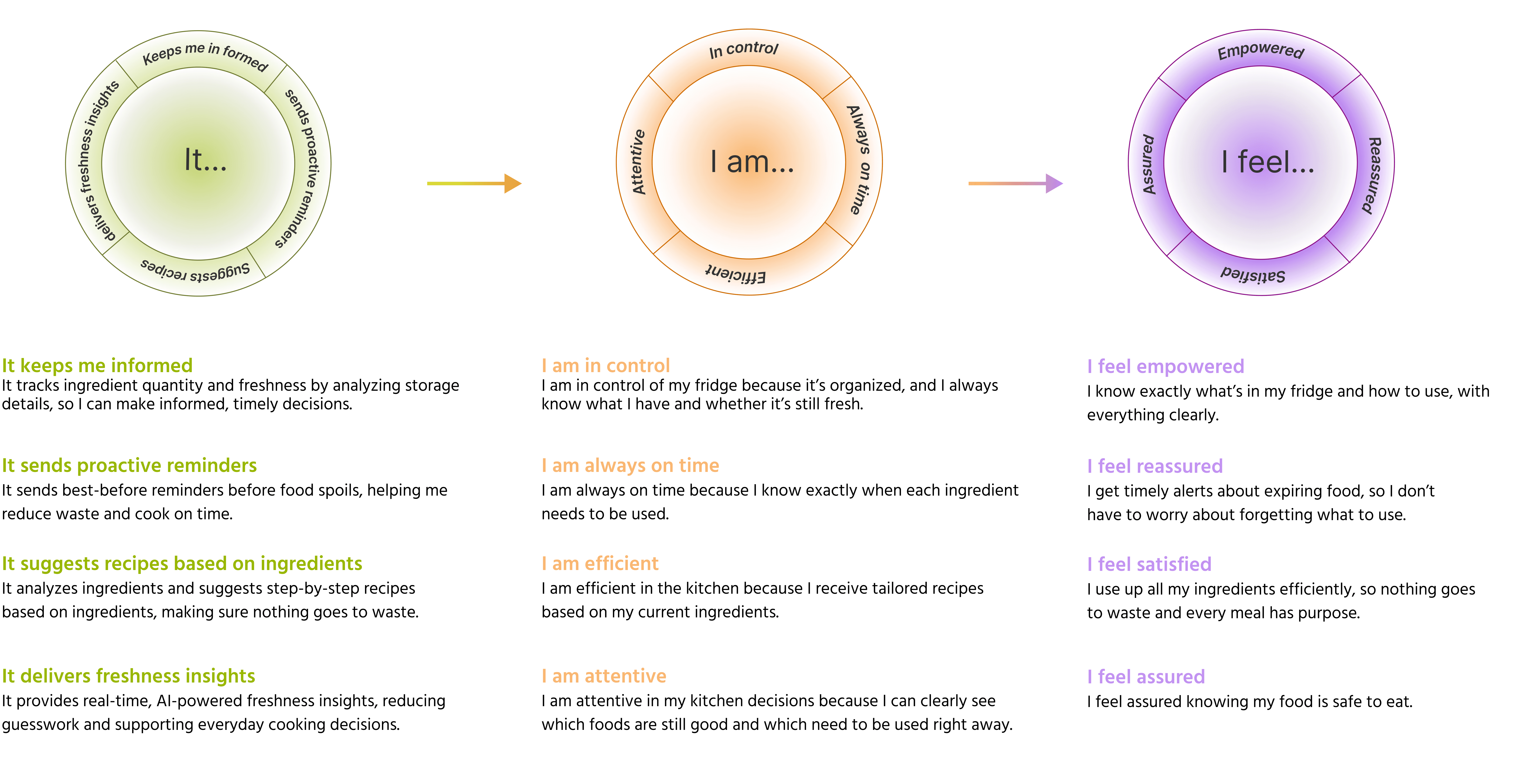
It keeps me informed
It tracks ingredient quantity and freshness by analyzing storage details, so I can make informed, timely decisions.
It suggests recipes based on ingredients
It analyzes ingredients and suggests step-by-step recipes based on ingredients, making sure nothing goes to waste.
I am in control
I am in control of my fridge because it’s organized, and I always know what I have and whether it’s still fresh.
I am always on time
I am always on time because I know exactly when each ingredient needs to be used.
I am efficient
I am efficient in the kitchen because I receive tailored recipes based on my current ingredients.
I am attentive
I am attentive in my kitchen decisions because I can clearly see which foods are still good and which need to be used right away.
Persona & User journey map
It sends proactive reminders
It sends best-before reminders before food spoils, helping me reduce waste and cook on time.
I feel reassured
I get timely alerts about expiring food, so I don’t have to worry about forgetting what to use.
I feel satisfied
I use up all my ingredients efficiently, so nothing goes to waste and every meal has purpose.
I feel assured
I feel assured knowing my food is safe to eat.
I am...
I feel...
It...
I feel empowered
I know exactly what’s in my fridge and how to use, with everything clearly.
It delivers freshness insights
It provides real-time, AI-powered freshness insights, reducing guesswork and supporting everyday cooking decisions.
Competitive analysis
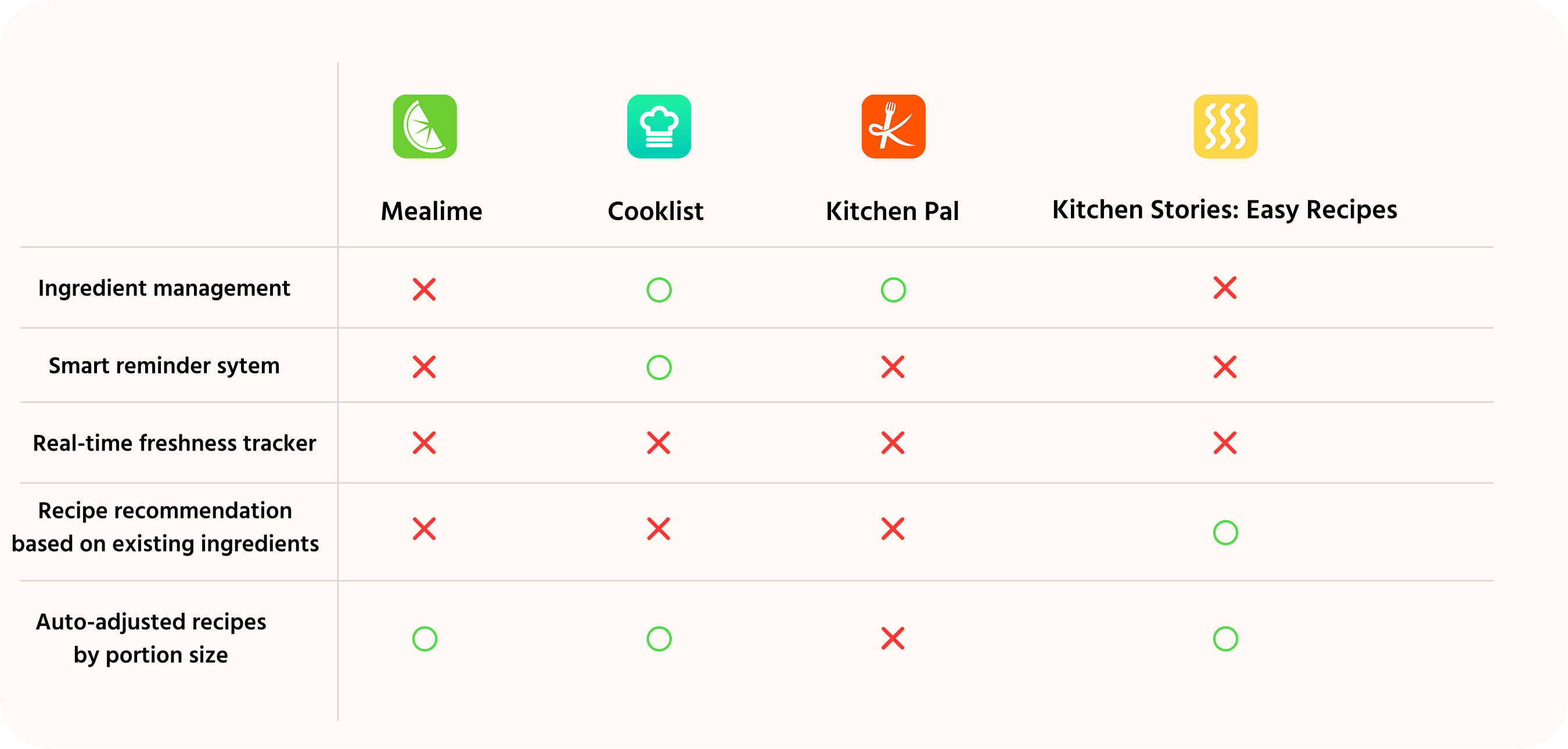
Ingredient management
Smart reminder sytem
Real-time freshness tracker
Recipe recommendation based on existing ingredients
Auto-adjusted recipes by portion size
Kitchen Stories: Easy Recipes
Kitchen Pal
Cooklist
Mealime


Voice of the customers
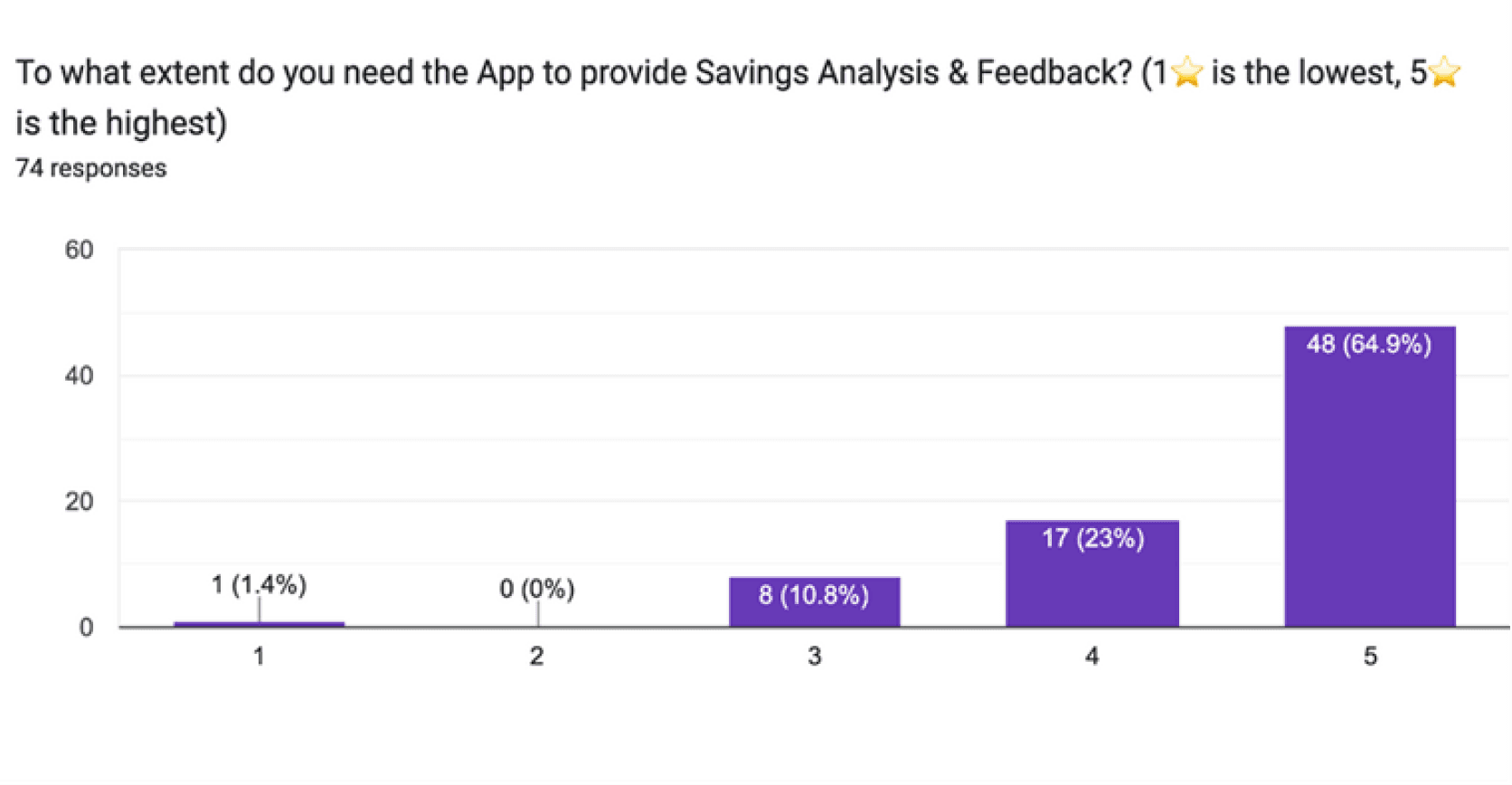
We surveyed 74 participants across varied income groups. Results revealed strong demand for automated input, freshness reminders, ingredient-based recipes, and savings feedback, highlighting the need for low-effort, time-sensitive support in everyday food management.
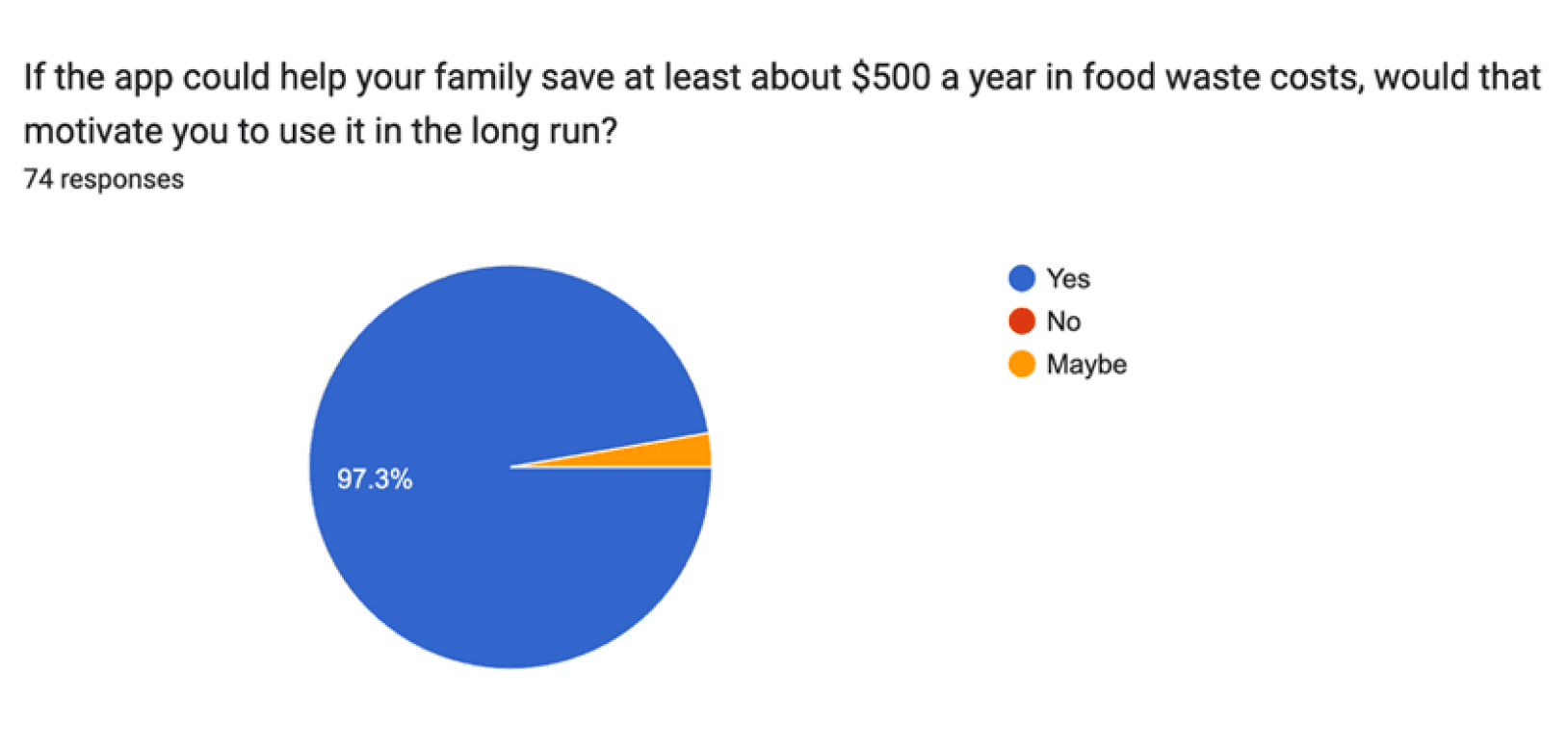
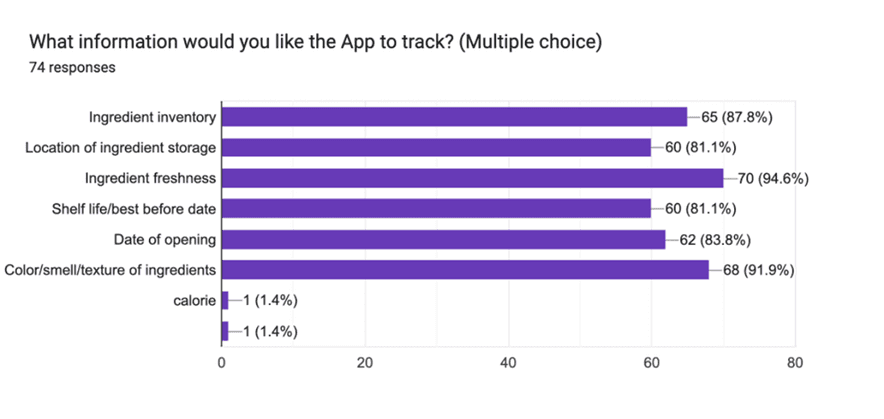
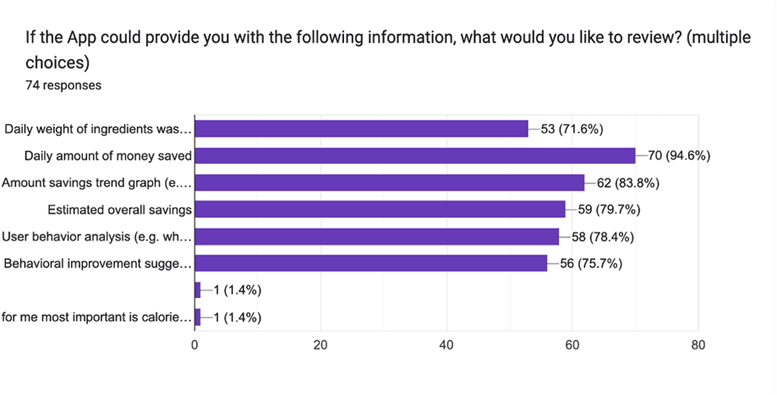
Persona & User journey map
By mapping user behaviors and data integration across each stage, we identified key friction points and opportunities in daily cooking decisions. AvoMate bridges the gap between inventory awareness and meal preparation, enabling users to reduce waste and cook more efficiently.
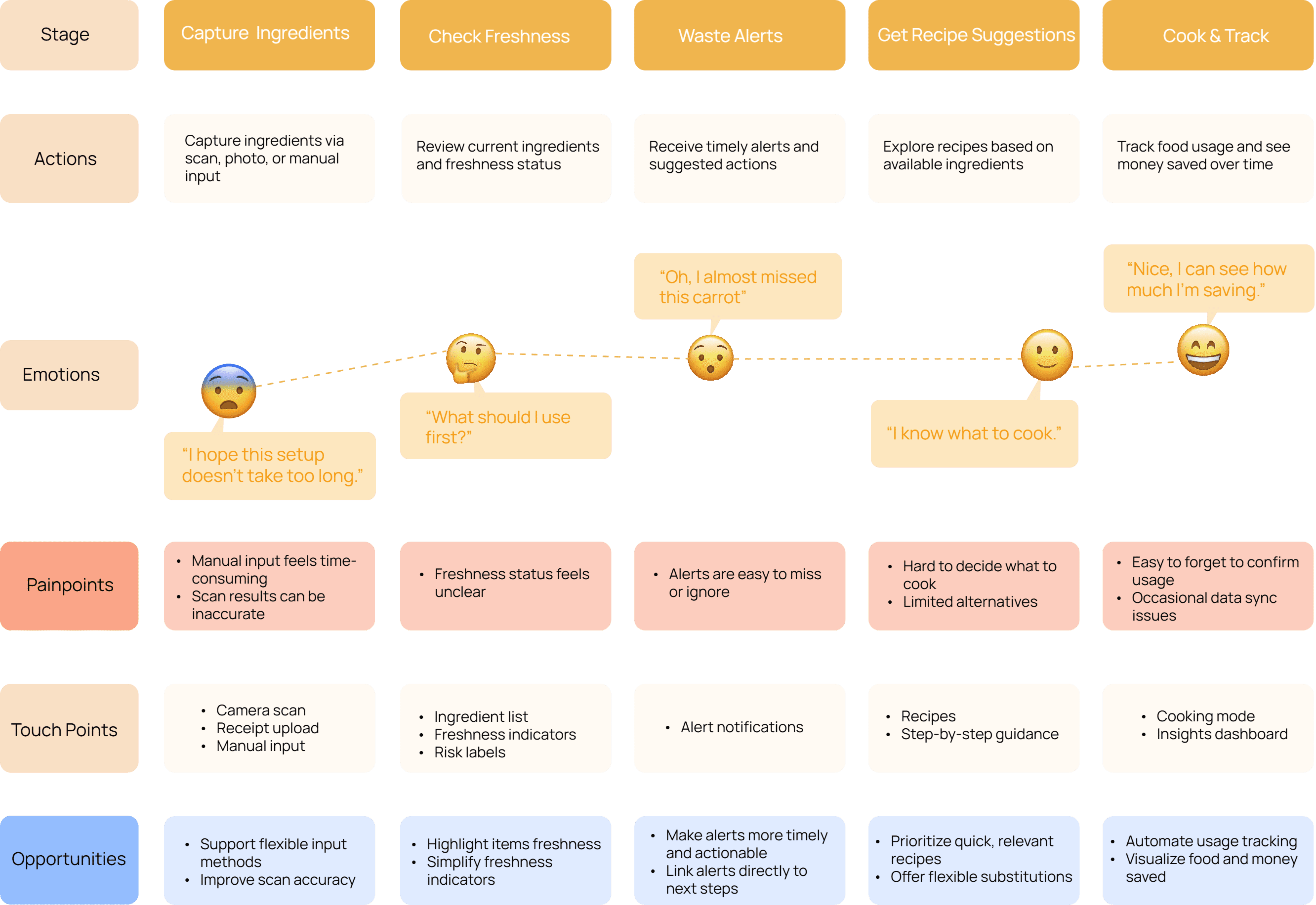
“I hope this setup doesn’t take too long.”
“Oh, I still have three carrots. This one should be used first.”
“Good thing it reminded me, I almost forgot about this”
“These recipes are actually based on what’s in my fridge.”
“My inventory updates automatically, and I can see how much food and money I’ve saved.”
Manual input feels time-consuming
Weight-based units increase cognitive load
Scan results can be inaccurate
Alerts may be missed
Unsure what to cook next
Recipes can feel overly complex
Limited alternatives
Easy to forget confirming usage
Occasional data sync issues
Cooking mode
Usage confirmation
Insights dashboard
Capture Ingredients
Check Freshness
Waste Alerts
Get Recipe Suggestions
Cook & Track
Scan grocery receipts
Photograph ingredients
Manual input ingredients
STAGES
ACTIONS
THOUGHTS
PAIN POINTS
EMOTIONS
TOUCH POINTS
View current ingredients
Review remaining freshness for each ingredient
Receive expiration notifications
Tap alerts to view suggested recipes
Browse ingredient-matched recipes
Open recipe details and follow guided cooking steps
Cook meals
Automatically or manually confirm ingredient usage
Review long-term insights
Freshness logic feels unclear
Hard to trust accuracy
Information can feel overwhelming
Camera scan
Receipt upload
Manual input
Freshness bars
Risk labels
Ingredient list
Push notifications
Alert cards
Recipe feed
Step-by-step cooking guidance
Auto-sort by urgency and highlight expiring items
Explain freshness logic
Add “Use Soon” indicators
Link alerts directly to relevant recipes
Predict spoilage earlier
OPPORTUNITIES
Support flexible input methods
Replace weight units with usage percentages
Default to scanning as primary input
Clearly show ingredient coverage
Prioritize quick recipes
Offer ingredient substitution options
Overwhelmed
(Input feels tedious)
In control & confident (Decision-making becomes effortless)
Surprise (Cooks in time before ingredients go bad)


Trust & satisfaction (Inventory updates automatically, progress feels visible)
Relief & clarity (Understands what needs to be used first by freshness)
Auto-deduct inventory after cooking
Trigger updates upon recipe completion
Surface long-term impact metrics
USER INFO
Name: Mario
Age: 26
Profile: Independent designer with a busy work schedule
Pain Points: Often forgets what’s in the fridge and struggles to decide what to cook
Goal: Reduce food waste while minimizing daily effort

SCENARIO
After work, Mario is too tired to decide what to cook. Noticing lettuce about to spoil, she opens AvoMate to quickly check freshness and recipe suggestions from her available ingredients, preparing dinner without waste or extra planning.
EXPECTATIONS
Low-Effort Input: Quick ingredient capture via receipt or photo scanning.
Clear Freshness Guidance: Instantly see what needs to be used first.
Relevant Recipes: Suggestions based on current ingredients.
Automatic Tracking: Inventory updates automatically after cooking.
Meaningful InsightsVisualize food and money saved over time.
Wireframe
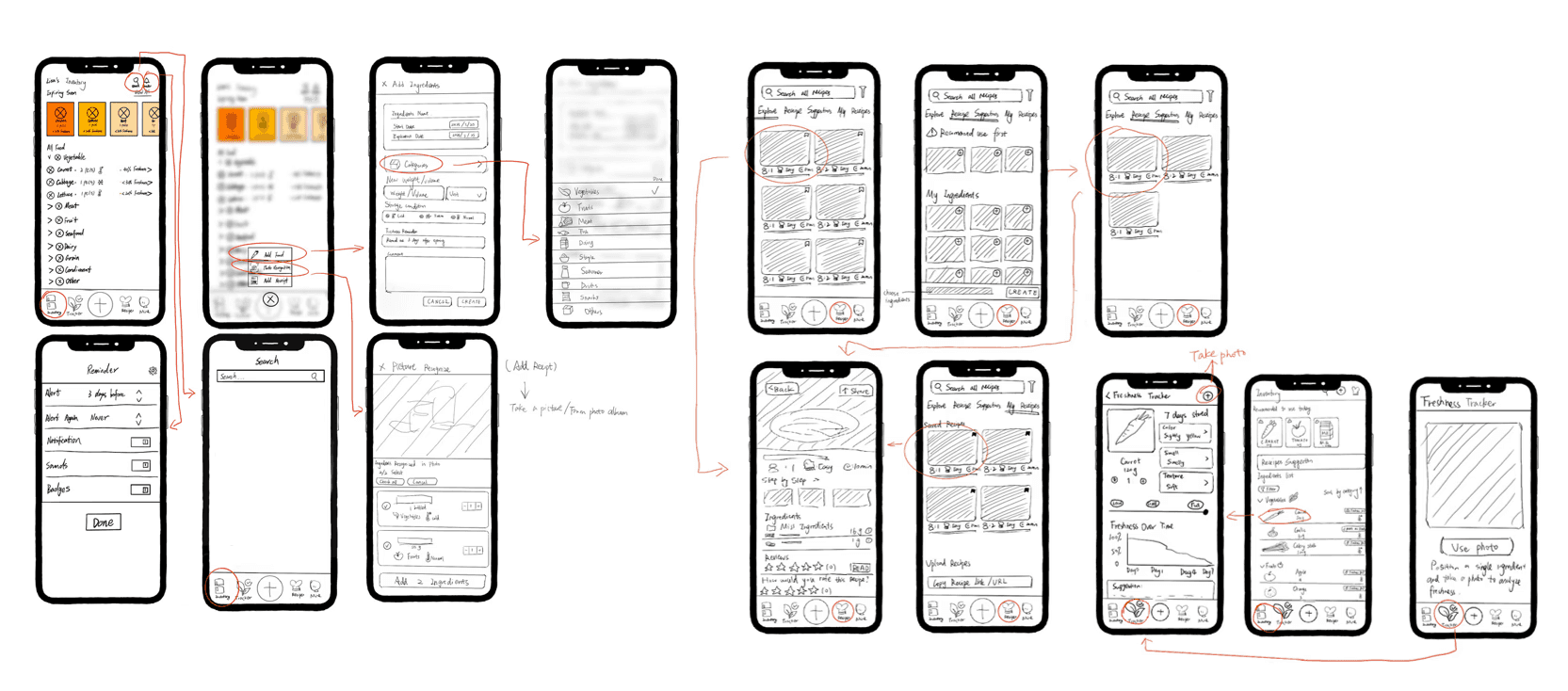
Low-Fidelity
Here are my initial low-fidelity explorations based on research insights and user needs. These early sketches helped visualize core flows.
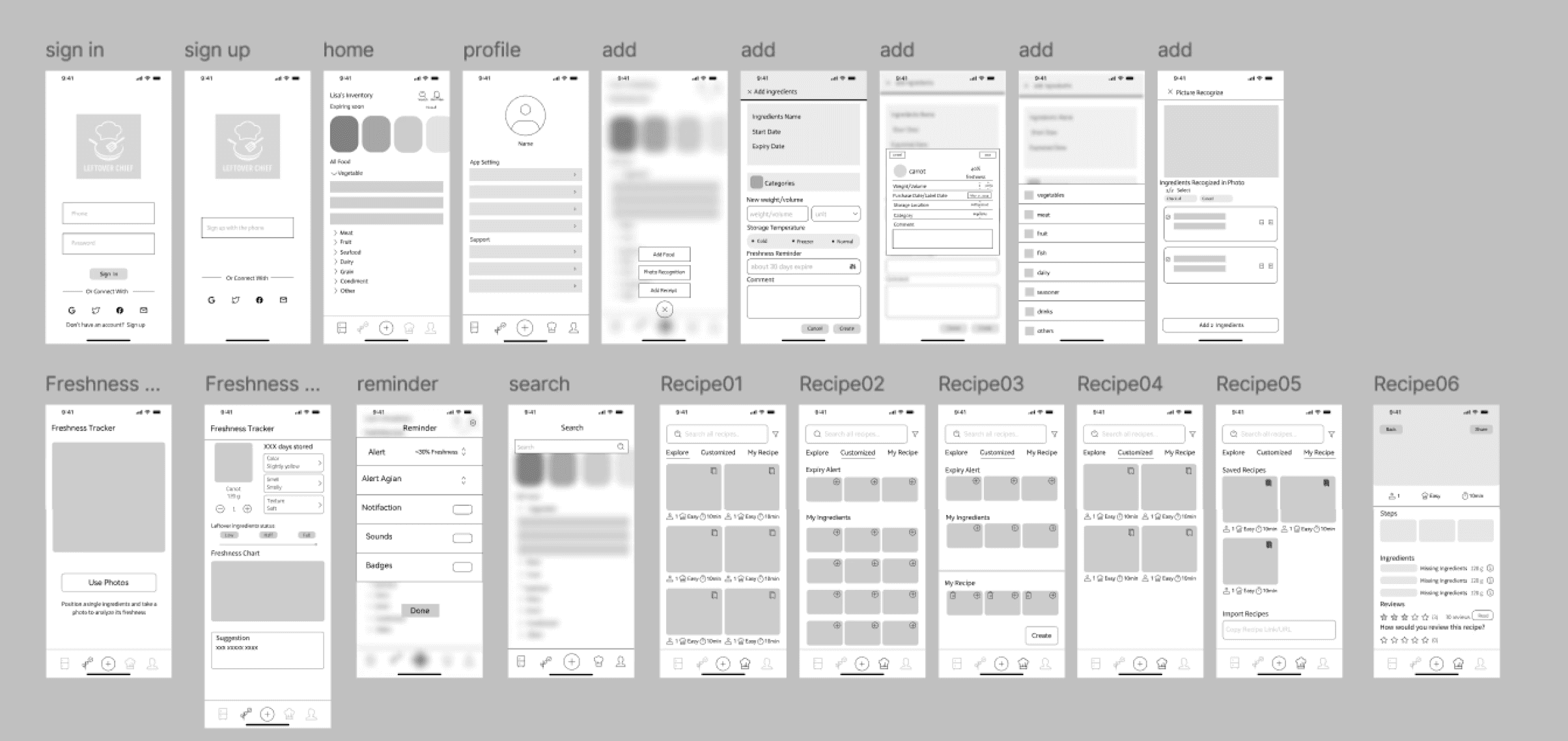
Mid-Fidelity
These mid-fidelity wireframes refine layout structure, user flows, and interaction patterns to validate key usability decisions.
High-Fidelity
These high-fidelity designs finalize visual language and interactions, transforming validated flows into a cohesive end-to-end experience.


User testing
We conducted usability testing with 18 target users to evaluate whether AvoMate’s inventory tracking and recipe features could help reduce food waste and support quicker cooking decisions.

Goals

28%
4.2/5
4.5/5

User satisfaction improvement on Inputting Ingredients
Ingredient freshness track rating
Recipe recommendation quality Rating
01 Input Ingredients
Evaluate how easily and quickly users can create their inventory
02 Freshness Tracking
Assess whether users can clearly recognize ingredient freshness through scanning.
03 Recipe Customization
Measure how efficiently users can generate customized recipes based on available ingredients.
04 Recipe Comprehension
Validate whether users understand the recipe page structure, ingredients, and cooking steps.
Design iteration
Through usability testing and iterative refinement, the following key improvements were made across inventory, freshness tracking, recipe customization, and profile experience.
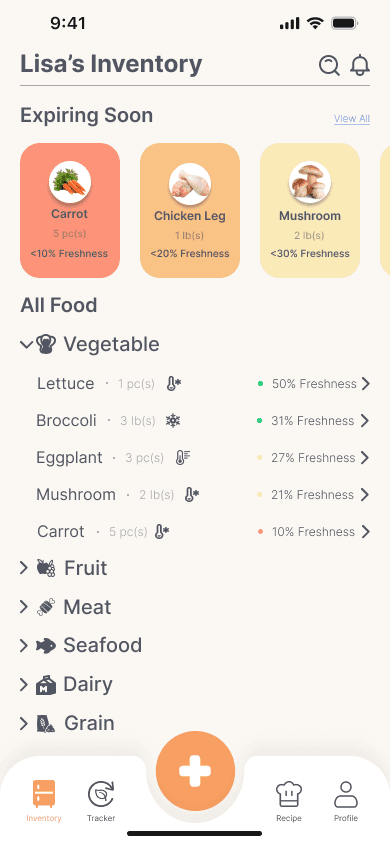
Before
Complexity: High
Clarity: Low
Ingredient list felt dense and text-heavy
Freshness status wasn’t immediately clear
Expiring items lacked visual priority
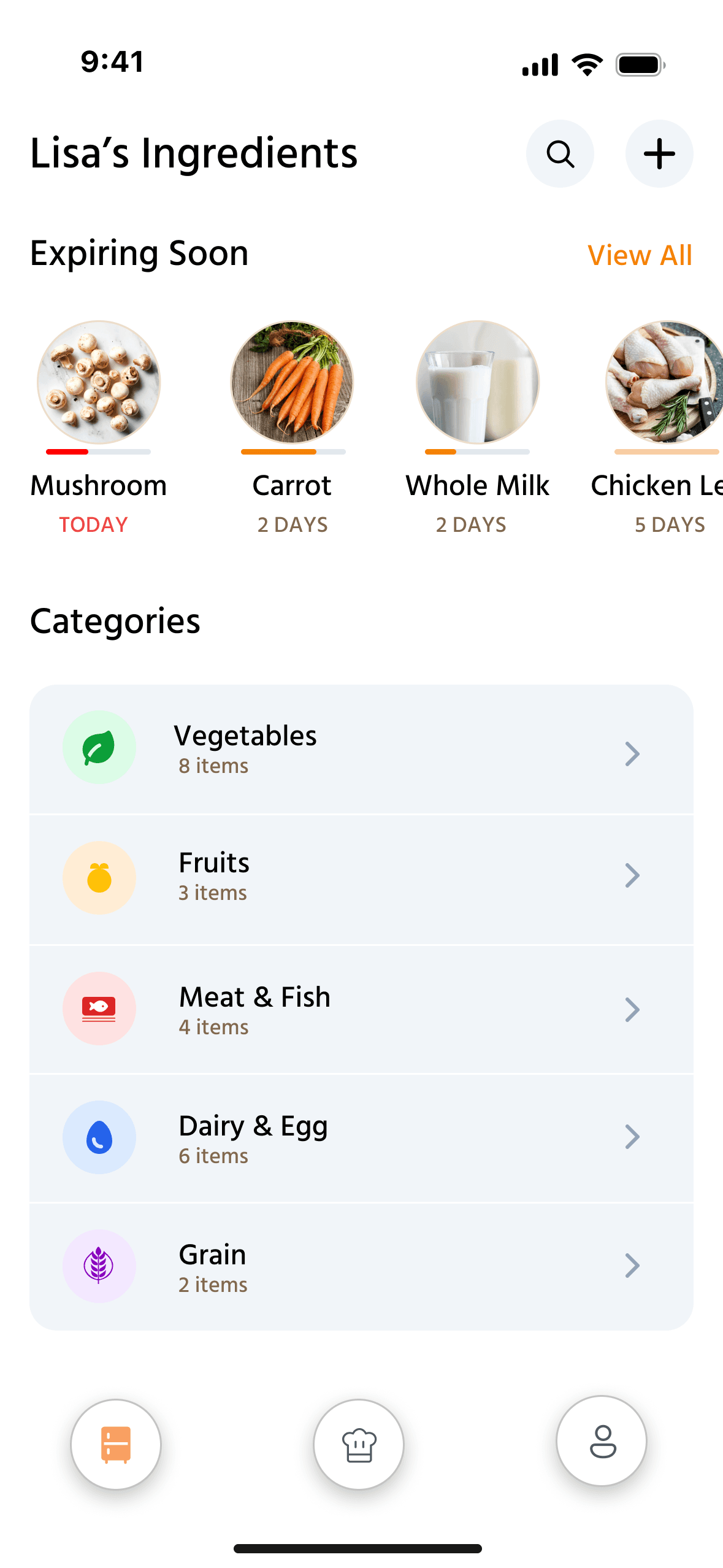
After
Complexity: Medium
Clarity: High
Grouped ingredients by clear categories
Added visual freshness cues
Prioritized expiring items at the top

Before
Complexity: High
Clarity: Medium-low
Freshness graphs lacked clear hierarchy
Excess secondary info increased cognitive load
Suggestions were buried under analytics
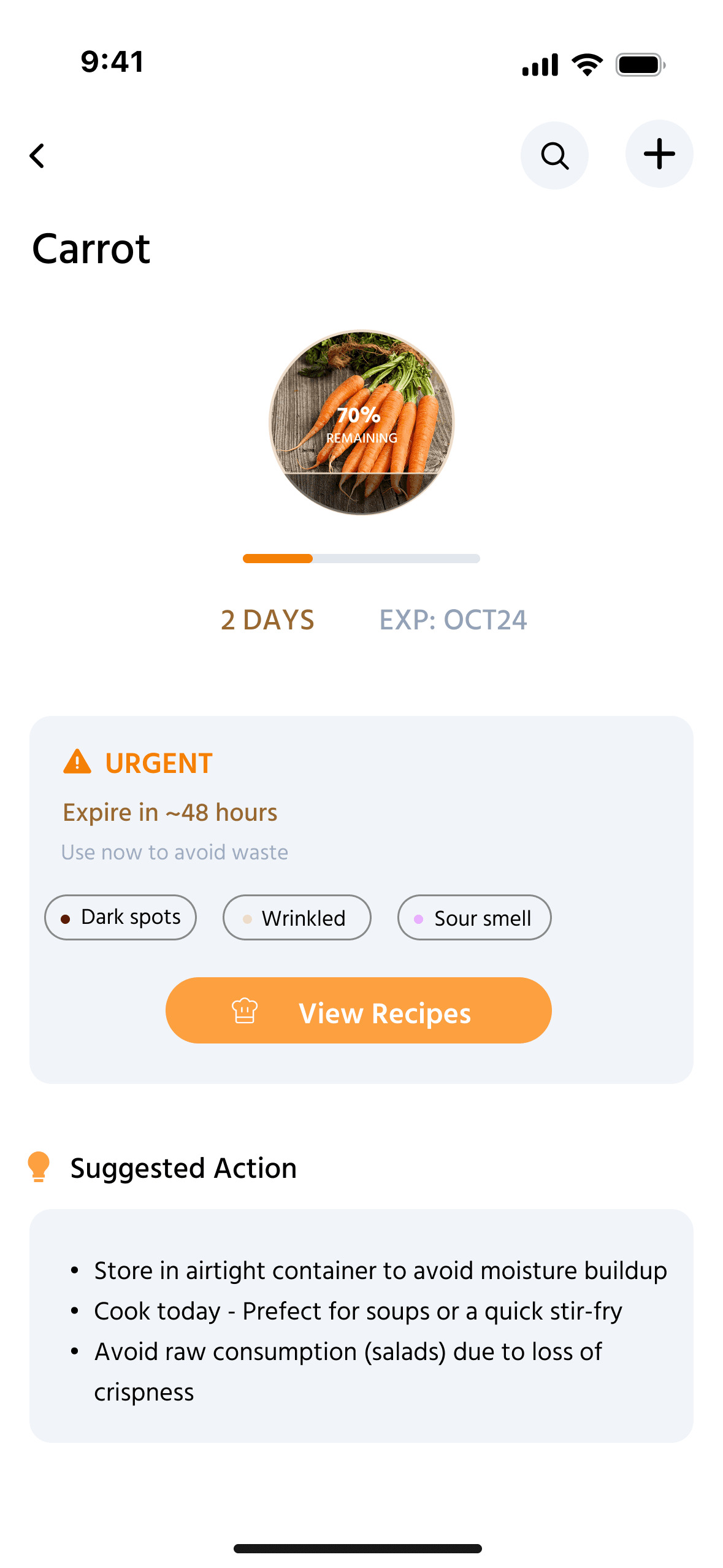
After
Complexity: Low
Clarity: High
Added “Urgent” alerts with direct recipe access
Highlighted key symptoms as tags
Turned freshness data into actionable guidance
Before
Complexity: Medium
Clarity: Medium
Users had to mentally match ingredients with recipes
Customization required too many steps
After
Complexity: Low
Clarity: High
Prioritized recipes based on available ingredients
Enabled quick recipe browsing
Simplified filters

Before
Complexity: Medium
Clarity: Low
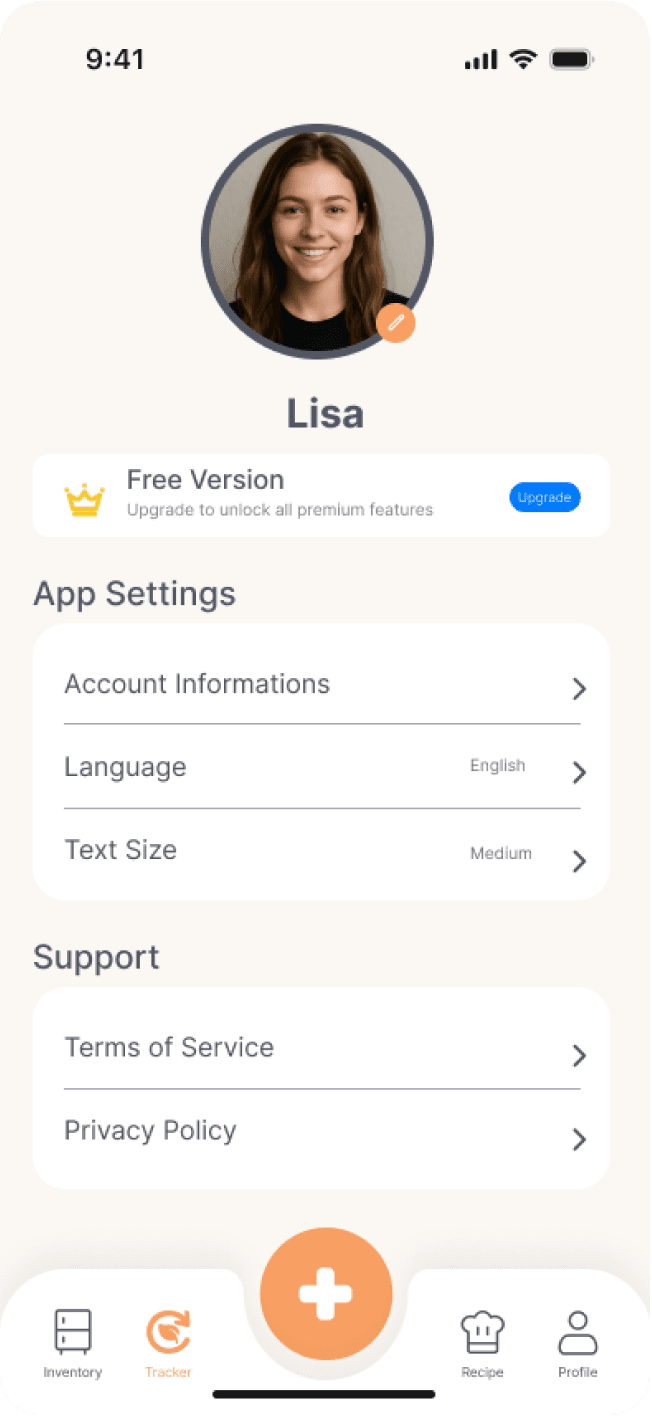
Profile focused on settings
Personal impact wasn’t visible
No feedback loop for waste reduction
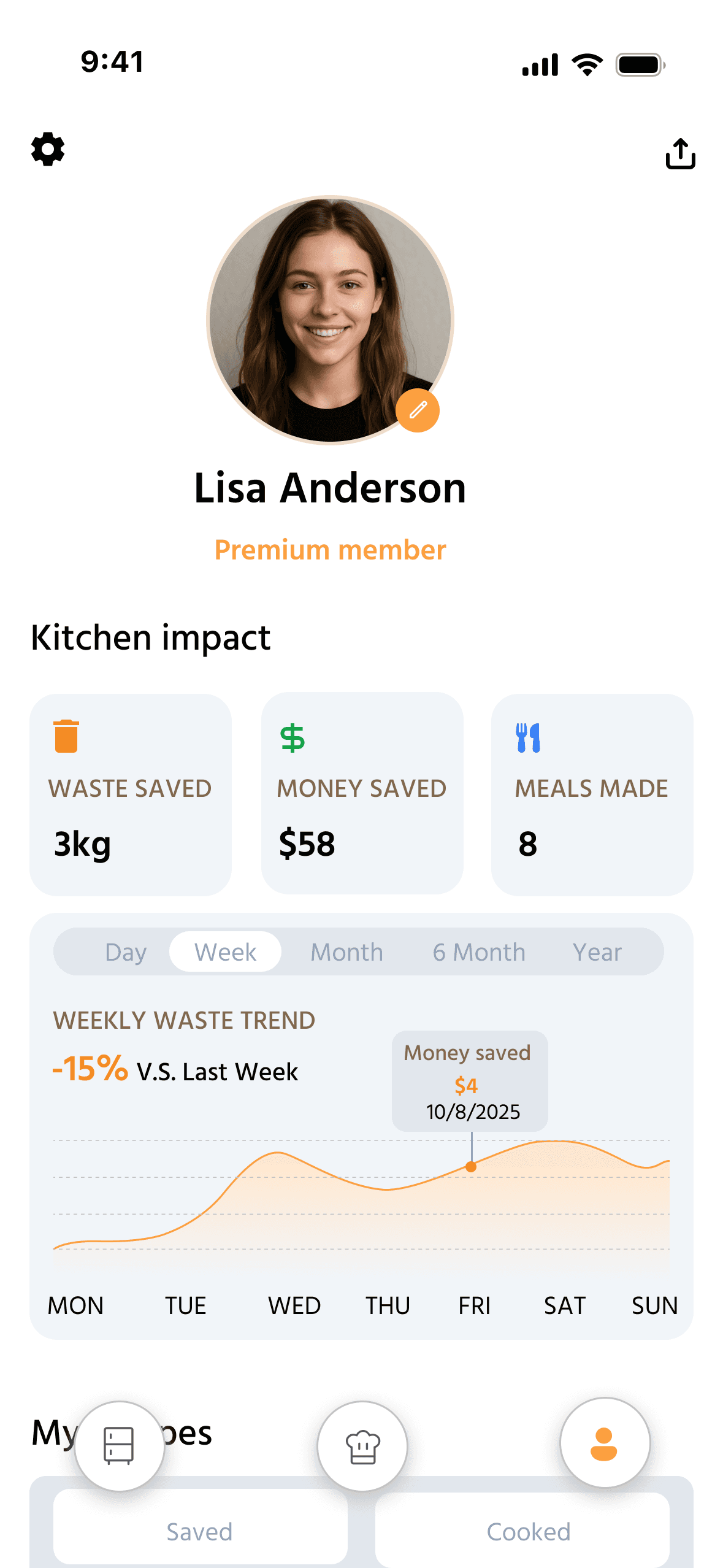
After
Complexity: Medium
Clarity: High
Created a visual feedback loop through Kitchen Impact metrics
Introduced time-based trends
Separated settings from personal performance

Manual Tracking
Smart Assistance
Interactivity
AvoMate

Passive
Interactive
Intelligent Guidance
Next Steps
Expand automated ingredient recognition by improving receipt parsing and image-based food detection accuracy.
Conduct longitudinal user testing to measure behavior change over time, including food waste reduction, cooking frequency, and retention.
Introduce smarter personalization by learning from cooking history and dietary preferences to refine recipe recommendations.
Explore integrations with smart appliances or grocery platforms to support end-to-end food management.
Project Summary & Reflection
Designing AvoMate reinforced that food waste is not a motivation problem, but a cognitive one. Most users genuinely want to waste less, they simply lack visibility and timely cues in their daily routines.
This project taught me the importance of designing for real-life context, not just screens: from standing in front of the fridge to making last-minute dinner decisions. I learned to prioritize clarity over complexity, action over information, and feedback over features. Through this process, I strengthened my ability to design behavior-driven experiences that reduce cognitive load, build trust, and support sustainable habits through small, meaningful moments.